

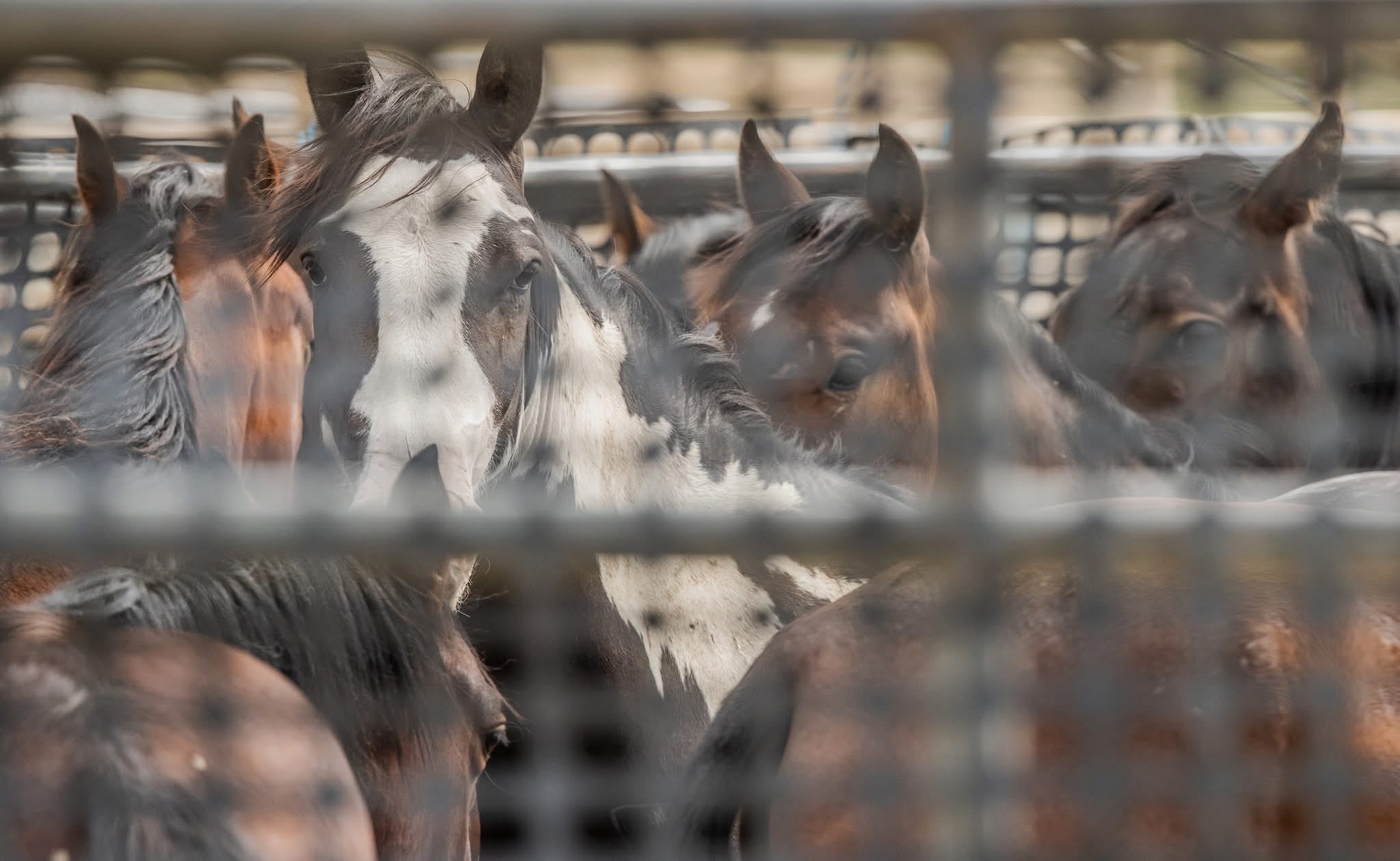
Photo Credit: Scott Wilson, PhotoAdvocacy
This is a long read, but a necessary one. If we do not understand the history of the BLM’s Wild Horse and Burro Program, we risk viewing each new scandal in isolation. Without that historical lens, we miss the continuity of the system. The history forces us to face a fundamental question: Are we witnessing fifty years of institutional failure, or are we seeing institutional intent?
TLDR:
A Failed Strategy: The agency ignores science-based fertility control in favor of expensive helicopter roundups, creating a self-perpetuating backlog.
The 50-Year Cycle: From 1980s “fee waivers” and 1990s “proxy adoptions” to the recent “Adoption Incentive Program” (AIP) scandal, to the latest sales-to- slaughter scheme, the mechanism changes, but the destination—kill pens—stays the same.
Current Crisis: Following the 2025 shutdown of the AIP, “Sale Authority” transactions have nearly tripled, showing the pipeline is far from closed.
The Bottom Line: Law without enforcement is just paper. Without Congressional accountability, the cycle is already repeating itself.
Last week I wrote about 15 wild Nevada mustangs purchased at a BLM adoption event in Livingston, Texas and delivered the same day to a kill pen three hours away.
Skydog Sanctuary immediately filed a complaint demanding prosecution of the buyer, who hours earlier had signed a BLM sales contract certifying — under penalty of federal criminal prosecution — that he would not do exactly what he then did. Skydog also demanded confiscation of the horses.
Skydog founder Clare Staples confirmed that BLM filed a law enforcement report and believes there are strong grounds for prosecution — if they can find a U.S. Attorney willing to pursue the case. (Pam Bondi, you’ve made animal welfare enforcement a priority as Attorney General. Are you listening?)
The agency did not confiscate the horses. Working with other rescues, Skydog has arranged placement for 6 of the 15. Nine — all between the ages of 3 and 8 — remain at the kill pen. The facility initially posted the horses as shipping to slaughter, then pulled them citing publicity. They are believed to ship this week if placement isn’t found. The current flood of BLM horses into kill pens has overwhelmed rescue capacity nationwide.
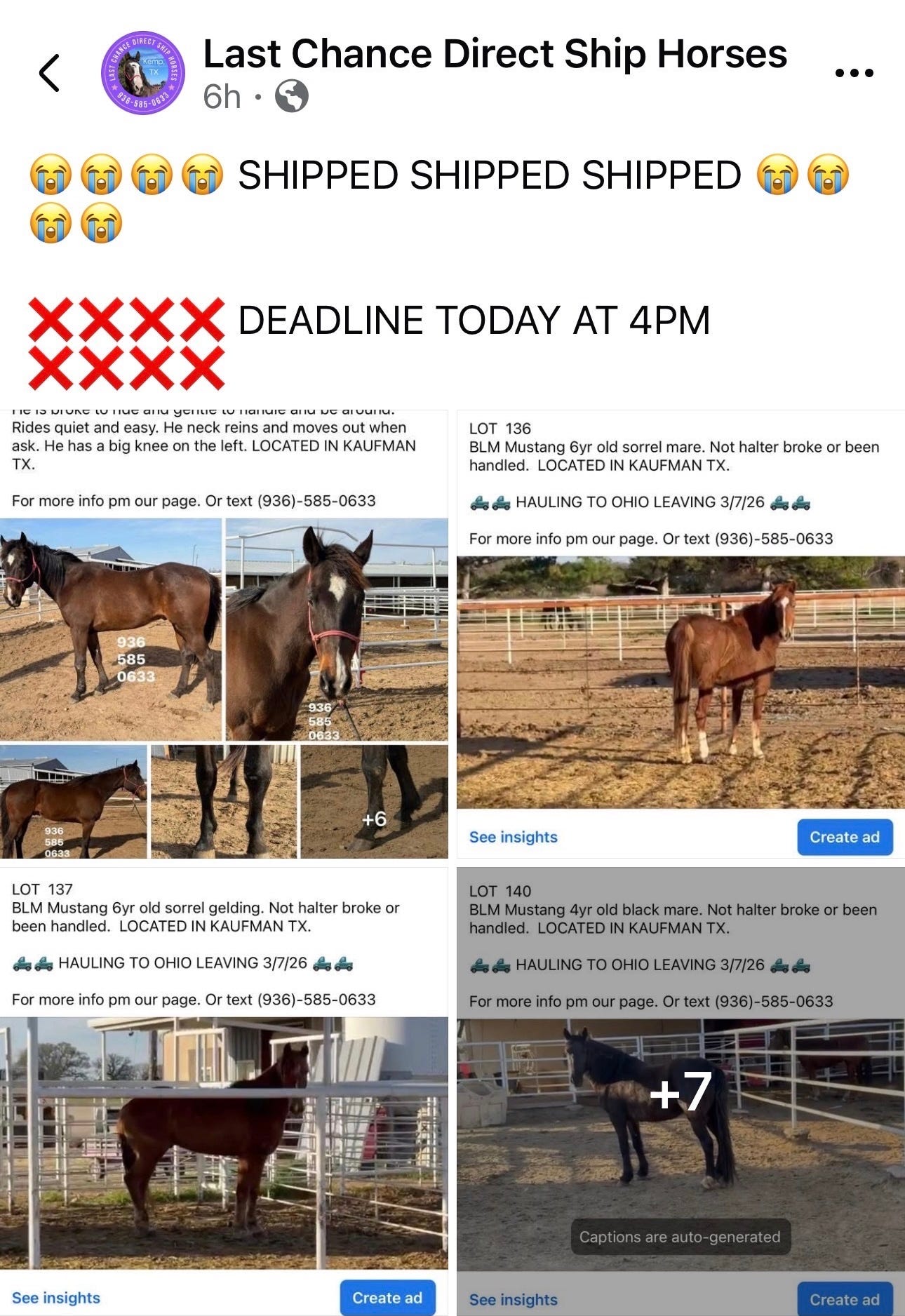
BLM's stated interest in holding the buyer accountable would mark a significant but welcome shift for an agency that has turned a blind eye for decades as federally protected wild horses flow into the slaughter pipeline. What we are witnessing right now is not new. It is at least the sixth iteration of the same scheme — each following the same pattern, ending the same way, and, after a brief pause, followed by another.
Why the Cycle Never Breaks
To understand why this keeps repeating, you have to understand the system that drives it.
Dating back decades, the BLM set a so-called Appropriate Management Level for the nation’s wild horse and burro population. The national AML is just under 27,000 — ironically, roughly the number that remained in 1971 when Congress protected them because they were “fast disappearing.” That AML was not derived from science, nor does it represent the carrying capacity of the land. It was negotiated with livestock permittees in the 1970s and 80s — the number of wild horses the agency decided to allow after allocating the lion’s share of forage to cattle and sheep. It has never been attained.
For fifty years, the BLM has chased its AML like a Holy Grail. Its mantra: “If we can just get to AML, everything will be ok.” The cycle is always the same: the agency cries overpopulation, Congress increases the budget, and BLM helicopters round up thousands of horses — far more than the adoption market can absorb. Holding facilities fill. Costs balloon. The agency quietly develops a mechanism to offload the backlog. That path leads to slaughter. The mechanism gets exposed — by journalists, by advocates, by the courts — and gets shut down. New procedures are announced. Then, after a short interval, a new scheme emerges. The horses keep moving. The pipeline never really closes.
It doesn’t have to be this way. Fertility control vaccines are safe, effective, and a fraction of the cost of a helicopter roundup. They have been proven to work — including at scale. But the agency has systematically underfunded and underutilized them, clinging instead to the “get to AML” strategy and a roundup system that has failed, by any measure, for five decades.
Pulitzer Prize-winning New York Times reporter David Philipps spent years investigating this program. In his book, Wild Horse Country, Philipps summarizes the situation:
“Since that day [of the BLM’s first roundup], the BLM’s main management tool — nearly the entire focus of the program — has been rounding up and removing horses…. It quickly became clear that the roundup policy had serious flaws and was so dysfunctional that no matter who ran it, and how much money they received, it was continually ending up in the ditch. And yet it is still the approach used today….”
“The fundamental approach has not changed much. It still follows a template created by mustangers a century before: Round ‘em up and move ‘em out.”
This, of course, is exactly what Congress was trying to stop when it passed the 1971 Wild Free-Roaming Horses and Burros Act.
The following history of the BLM’s slaughter schemes is based on Philipps’ book, a must read for all those working in the wild horse and burro protection space.
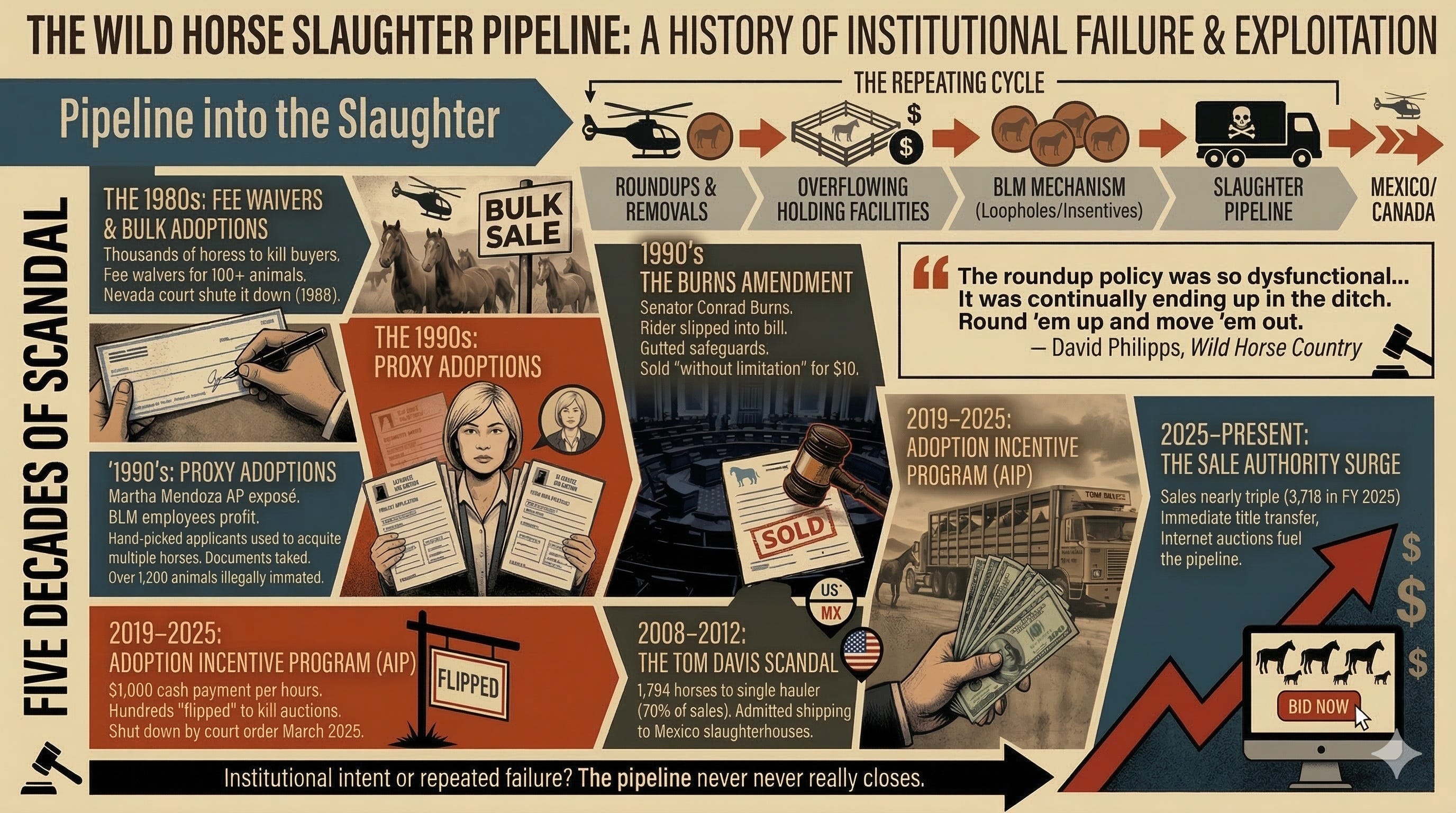
The 1980s: Fee Waivers for Bulk Adoptions
In 1978, the BLM began removing thousands of horses annually, eventually ending up with 10,000 in captivity and paying feedlots to warehouse them. Looking for a way to offload captured horses, the BLM started offering fee waivers to anyone willing to take 100 or more animals. Between 1985 and 1988, the BLM had placed more than 20,000 horses with large-scale adopters. Two-thirds of the agency’s placements that year were fee waiver adoptions, mostly to kill buyers.
Thousands of wild horses went to slaughter before the U.S. District Court in Nevada shut it down, ruling that the BLM knew what was happening but turned a blind eye. The Ninth Circuit Court of Appeals upheld the ruling, and by 1988, the program was terminated.
The BLM then explored mass euthanasia by lethal injection, but in 1988 Congress shut that down with an appropriations rider prohibiting the destruction of healthy horses and burros.
The 1990s: The Proxy Adoption Scandal
The BLM next found a loophole to exploit to offload horses. The Wild Free Roaming Horses and Burros Act limited adoptions to four animals per person. But agency regulations allowed for proxy adoptions. One adopter could bring proxies for multiple adopters and adopt four horses per adopter. Kill buyers began to adopt wild horses and burros in large numbers, and again the BLM looked the other way.
In 1997, Associated Press investigative journalist Martha Mendoza exposed the corruption in a seven-part series. The program had lost track of more than 32,000 adopted animals. BLM employees were among those profiting from slaughter. Officials had falsified records and suppressed internal warnings. A federal grand jury collected evidence that BLM officials had allowed the slaughter of hundreds of wild horses. The case was eventually closed after the Department of Interior pressured the Department of Justice to shut it down.
That same year, Public Employees for Environmental Responsibility (PEER) issued a report on the scandal, detailing the shocking findings of BLM internal investigators that had been quashed by BLM and DOI higher ups. They included:
theft of wild horses during BLM sponsored “gathers” or captures;
“black booking” or phony double branding of horses so that duplicate branded horses could disappear without a paper trail.
manipulation of wild horse adoptions where one person holds the proxies for a group of supposedly separate adopters and the horses all end up at slaughter;
use of satellite ranches to hold horses for days or weeks as stopping points on the way to slaughter;
fraudulent use of wild horse sanctuaries - ranches subsidized by the federal government to care for unadoptable wild horses deemed excess and removed from the range as fronts for commercial exploitation.
According to Philipps:
“The public revelations of slaughter in the 1990s had the same effect as public revelations of slaughter in the 1980s: The BLM tightened adoption rules, making it harder to sell horses to slaughter, and vowed once again not to give horses to anyone who intended to sell them to slaughter. The agency also got all the slaughterhouses in the United States to agree to alert the government when wild horses showed up in their lots. But the BLM did not make any serious efforts to change the roundup strategy, which had been the driving factor in sending so many horses to the dog-food factory. The helicopters kept flying.”
2004: The Burns Amendment
The adoption protections under the Act required adopters to care for their horses or burros for a year and pass a compliance inspection before gaining title to the animals. So the late Montana Senator Conrad Burns came up with an end run around that protection. In December 2004, he slipped a rider into a 3,000- page appropriations bill in the middle of the night. Most members of Congress never knew it was there. The Burns Amendment gutted the adoption safeguards, allowing BLM to sell any horse over the age of 10, and any younger animal unadopted after three tries, “without limitation” — including for commercial slaughter — at prices as low as $10 per animal, with immediate title transfer.
Congress responded by adding annual appropriations language prohibiting the destruction of healthy wild horses and prohibiting the use of funds for sales resulting in destruction for commercial processing. The prohibition was unambiguous. The enforcement was not.
2008–2012: The Tom Davis Scandal
Between 2008 and 2012, BLM sold approximately 1,794 wild horses to a Colorado rancher and livestock hauler named Tom Davis — 70 percent of all animals sold through the program during that period. Like every buyer, Davis signed a contract certifying he would not sell the horses for slaughter. Davis admitted to federal investigators that most of them went to slaughter facilities in Mexico.
Philipps exposed this latest scandal in a report for ProPublica. A Department of Interior Office of Inspector General investigation confirmed that BLM had violated its own policies and looked the other way even after receiving complaints.
Davis had told BLM employees the horses were going to good homes — for use in movies, on oil fields. BLM accepted these explanations without question. Both federal and state prosecutors declined to bring charges.
2019–2025: The Adoption Incentive Program
BLM didn’t even wait a full decade before the next slaughter scheme came on line.
In 2019, BLM launched the Adoption Incentive Program, paying $1,000 per animal to adopters — up to four animals per person. Adoptions surged. So did the slaughter pipeline. A 2021 Philipps’ investigation for the New York Times reported that truckloads of AIP horses were ending up at kill auctions as soon as incentive payments cleared adopters’ bank accounts. An American Wild Horse Conservation investigation documented at least 840 AIP horses in kill pens over 19 months. The report documented that groups of related individuals were adopting four horses per person, then flipping the animals to kill pens as soon as the incentive payments hit their bank accounts.
BLM made minimal adjustments. Enforcement remained nonexistent. The BLM kept adopting horses to individuals they knew were sending them to slaughter auctions. The program was finally shut down by court order in March 2025.
2025–Present: The Sale Authority Surge
Within months of the AIP’s shutdown, sale authority sales nearly tripled — from 1,509 in FY2024 to 3,718 in FY2025, the highest on record. The mechanism is different. The outcome is the same.
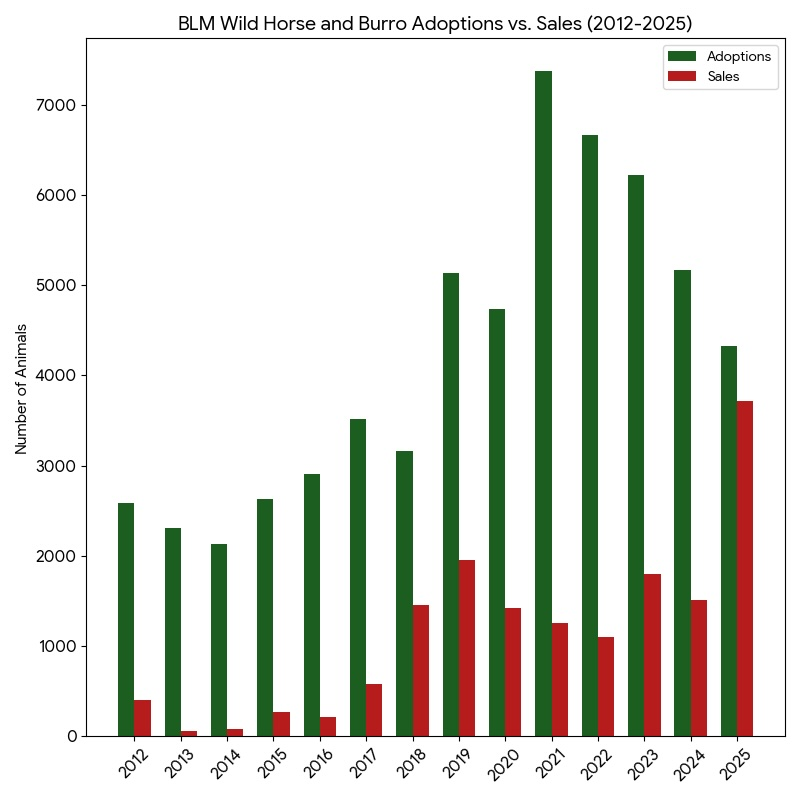
The graph shows a spike in adoptions related to the AIP, followed by a spike in sales after the AIP program was terminated. Based on BLM data.
The BLM is running internet auctions with hundreds of horses at a time, far more than the adoption market can absorb. (The current internet adoption has nearly 700 animals up for adoption and sale.) Horses and burros over the age of ten are automatically offered for sale, while younger horses who go unclaimed after three postings are also qualified for sale authority. Buyers sign the same federal certification as adopters — under penalty of prosecution under 18 U.S.C. 1001 — that they will not sell the animals for slaughter. And as in every previous iteration of this scheme, violators are never prosecuted.
It remains to be seen whether BLM will actually prosecute this case and the many others we know are ongoing. But what we do know is that 63,000 wild horses and burros currently sit in government holding facilities at a cost of more than $100 million a year to American taxpayers, with thousands more scheduled for roundup, including nearly 5,000 in a single Nevada operation.
Without effective oversight, the agency has every incentive to keep the pipeline moving. It has demonstrated, across five decades, that it will. The law to protect these horses is meaningless as long as the agency charged with enforcing it fails to do so.
The only question that matters at this point is whether Congress will finally demand accountability. Or whether it will again fall to the public — through sustained outrage, media attention, and legal action — to do Congress’s job for them. The next scheme may already be underway. The cycle will continue.
The ghosts of tens of thousands of wild horses and burros — born free on the vast western range, promised protection under federal law, rounded up and slaughtered while the agency looked away — remind us that a promise written into law means nothing without the will to enforce it.
Great post!
How do we make it go viral to the American public?
How do we get the American public to do something to help the Mustang Freedom?
My thoughts:
1. Education (every American should read Ms. Henry's book "Mustang, Wild Spirit of the West" about Wild Horse Annie.
2. Compensatory reproduction and feral/wild animal populations. Needs to be considered.
3. Physical management and trapping, sterilization, and culling. Should a professional team be assigned to each HMA to monitor and control the herd's population?
4. What if only the old Mustangs were removed from the wild, leaving a young and vibrant herd to live free-roaming? Would that help control the population (along with birth control)? The herd would not "compensatory reproduce" because they would have their young.
thank you Suzanne the BLM needs to be shutdown too.xxx